Capertee Colour in Painting Retreat Information
4-Day Colour Intensive Artist Retreat
Where we start
The first day of your retreat begins with a welcome at 1 pm at Capertee Mountain View Artist Retreat. You’re welcome to arrive any time from 10 am to settle in, unpack, have lunch and make yourself comfortable.
Capertee Mountain View Artist Retreat is located at Nguluway,1 Port Macquarie Rd, Bogee, in the Capertee Valley. Detailed directions can be found here.
Please note that there is limited mobile reception throughout the valley, so it’s best to download the directions in advance. Generally, there is reasonable coverage on-site during the retreat.
What’s included in your 4-day retreat?
Painting tutorials on aspects of colour - hue, value, saturation, strategies and interactions
Guided, individual mentoring and feedback from Corinne each day
Comfortable facilities and beautiful views at Capertee Mountain View Artist Retreat, including the shared kitchen and bathrooms, fire pit and optional accommodation
Use of the Woolshed studio, and access to the property paddocks and bushland
Opportunity to visit Glen Davis, Dunn’s Swamp/Ganguddy, Wollemi or Capertee National Parks to paint en plein air.
What to Bring
Food
Artists can self-cater in the fully equipped kitchens, cook over the fire or on the BBQ and/or enjoy the local restaurants at Rylstone, Kandos and Glen Alice.
Fridges, appliances, cooking utensils and equipment are available in Peppertree Cottage as well as the Hayshed kitchen. Each van is equipped with a fridge and a kettle.
Evenings are a highlight, with fireside conversation, food, and drinks.
If you’re travelling from afar, you could buy food in Rylstone or Kandos on your way through.
General Equipment
Bring whatever helps you feel comfortable and creative, including:
Sheets and towels
Journal, pen, and pencil
Walking shoes and a rain jacket
Hat, sunscreen, lip balm and sunglasses
Warm clothing for cool evenings
Backpack and water bottle
Painting Materials and Equipment
Please use the lists below as a starting point and add your own favourite materials. You’re encouraged to experiment and explore — this retreat is the perfect place to try new techniques and tools.
A limited number of Easels are available for loan for the duration of the retreat, but these must be booked at least 2 weeks in advance.
For more detail, see Corinne’s article: The Art of Plein Air Painting – a guide to outdoor painting approaches and equipment.
-
PAINT
I recommend Atelier Interactive acrylic 80 ml tubes in the following colours. They are widely available, even at Officeworks and Spotlight - and their prices are often cheaper than art shops.
Titanium White
Carbon Black
Cadmium Yellow Light / Arylamide Yellow Light
Cadmium red medium
Alizarin Crimson
French Ultramarine
Cerulean Blue / Pthalo Blue
Permanent Sap Green
Magenta
Burnt Umber
Yellow Ochre / Burnt Sienna
If you prefer to buy a set (as in below), then supplement with the following:
Black
Magenta
Cerulean / Pthalo Blue
Permanent Sap Green
Yellow Ochre / Burnt Sienna
Set contains: Titanium White, Burnt Umber, Arylamide Yellow Light, Cobalt Blue Hue, Napthol Red Light, Crimson
MEDIUMS - optional
Retarder medium slows drying and is especially useful outdoors
Impasto thickens paint - if you want to work with textured paint
CANVASES/BOARDS
You can purchase packs of ply or canvas boards or stretched canvases in a range of sizes, for example, 4 of 12” x 16”, 3 of 10” x 12” etc. Good quality paper is also fine.
BRUSHES
I recommend buying 5-8 hog's bristle brushes and more synthetic ones in different sizes and shapes. The most versatile are filberts. The styles of brush seen most commonly are:
Round: sometimes a pointed tip, long closely arranged bristles for detail.
Flat: for spreading paint quickly and evenly over a surface. They have longer hairs than Brights.
Bright: shorter than flats. Flat brushes with short stiff bristles, good for driving paint into the weave of a canvas in thinner paint applications, as well as thicker painting styles like impasto work.
Filbert: flat brushes with domed ends. They allow good coverage and the ability to perform some detail work - most useful shape.
Fan: for blending broad areas of paint.
Angle: like the filbert, these are versatile and can be applied in both general painting application as well as some detail work.
Mop: a larger format brush with a rounded edge for broad soft paint application, washes as well as for getting thinner glazes over existing drying layers of paint without damaging lower layers to protect the paintbrush
EQUIPMENT
Sketchbook - A4 or larger
Canvases/Boards/or Canvas Paper
Easel (if you don’t have one, you may be able to borrow one - email Corinne)
Brushes - bring a range of sizes and types
Palette knives - 2 to 3
Palette - A plastic clear document holder, flat plastic food container or clip board makes a great portable palette. A wet cloth with a sheet of baking paper on top can be easily cleaned up and stays usable for longer.
Paints
Retarder medium - recommended
Water
Jar to clean brushes
Paper towel/rags
Coloured/graphite pencil
Bulldog Clips
Apron
Baby wipes
Plastic bag
Hat
Folding chair
Small folding table
Sunscreen
Stanley knife/pencil sharpener
Spray bottle
Any other art materials you want to work in
Bubble wrap, glassine paper, old sheets or boxes to wrap your work for transportation.
-
PAINT
I recommend the following colours in Art Spectrum, Windsor and Newton or another professional quality paint.
Zinc white
Titanium white
Lemon yellow
Spectrum or cad yellow
Yellow ochre
Spectrum vermillion/cad red
Alizarin or spectrum crimson
Magenta
Spectrum or Flinders violet
Ultramarine blue
Pthalo or Prussian blue
Sap Green
Burnt Sienna
Raw Umber
Ivory or Lamp or Transparent Black
MEDIUMS
The most versatile medium is Liquin. Not necessary to buy unless you want to try it.
SOLVENT
Only Coconut oil brush cleaner of odourless solvent is permitted in the studio for the safety of all participants. Bring a spare jar to store dirty solvent for reuse.
SUPPORTS
Bring a few sheets of canvas paper and a range of sizes of primed plywood or canvas boards or stretched canvases, for example, 3 of 12” x 16”, 2 of 10” x 12” etc.
BRUSHES
BRING a minimum of 7 - 10 hog's bristle brushes and a few synthetic ones in different sizes and shapes. The styles of brush seen most commonly are:
Round: sometimes a pointed tip, long, closely-arranged bristles for detail.
Flat: for spreading paint quickly and evenly over a surface. They have longer hairs than Brights.
Bright: shorter than flats. Flat brushes with short stiff bristles, good for driving paint into the weave of a canvas in thinner paint applications, as well as thicker painting styles like impasto work.
Filbert: flat brushes with domed ends. They allow good coverage and the ability to perform some detail work - I find this the most versatile brush.
Fan: for blending broad areas of paint.
Angle: like the filbert, these are versatile and can be applied in both general painting application as well as some detail work.
Mop: a larger format brush with a rounded edge for broad soft paint application, washes as well as for getting thinner glazes over existing drying layers of paint without damaging lower layers to protect the paintbrush
EQUIPMENT
Sketchbook - A4 or larger
Few sheets of canvas paper
Canvases or Boards
Easel (if you don’t have one, email Corinne - you may be able to borrow one)
Brushes - bring a range of sizes and types
Palette knives - 2
Palette - A plastic clear document holder, flat plastic food container or clip board makes a great portable palette
Paints
Odourless Solvent and two glass jars with lids
Paper towel/rags
Coloured/graphite pencil
Bulldog Clips
Apron
Baby wipes
Plastic bag for keeping dirty rags
Hat
Folding chair
Small folding table
Sunscreen
Stanley knife/pencil sharpener
Any other art materials you may like to use…watercolours etc
Boxes for the transportation of wet oil paintings. Please see the photos below
-
PAINT
Bare minimum:
• Spectrum Yellow - Art Spectrum brand (AS)
• Cadmium Red - Shminke brand (Sh)
• Ultramarine Blue (AS or Sh)
• Prussian Blue (AS or Sh)
Useful extras:
• Cerulean Blue (AS)
• Burnt Umber (Sh)
• Lemon Yellow (AS or Sh)
Other good brands - Rembrandt, Old Holland, Windsor and Newton, ( W&N have a cheaper student range of ‘Cottman’ watercolours as well as an artist-quality range.)
PAPER
100% Cotton paper - several single sheets or a pad of paper ( 10 sheets minimum) of the size you want - A4 or A3 depending on how quickly you work. We will also be doing some exercises for which you will need paper.
Good options: Arches 185 gsm or 300 gsm or Saunders Waterford 200 gsm
( Heavier weight paper is better, but 185 gsm is fine for small works up to A3)
Note - good 100% cotton paper is fairly expensive. You might be tempted to get wood pulp paper because it is cheaper. It is much harder to paint on. ( If it doesn’t say 100% cotton, it is most likely wood pulp.)
BRUSHES
3 sizes
Small - about size 3 round
Medium - size 8 - 10 round
Large - size 12 round or 3/4 “ inch flat brush
Mostly, students get synthetic brushes as they are more affordable.
HB pencil
Kneadable eraser ( putty rubber )
A palette of white plastic ( or cheap white plastic bowls ) to mix in.
Spray bottle
Mediums if you prefer
Easel (if you don’t have one, let Corinne know to bring an extra one)
Water
Jar to clean brushes
Paper towel/rags
Bulldog Clips
Apron
Baby wipes
Plastic bag for rubbish
Hat
Folding chair
Small folding table
Sunscreen
Stanley knife/pencil sharpener
Any other art materials you want to work in

Plein air painting near Alice Springs
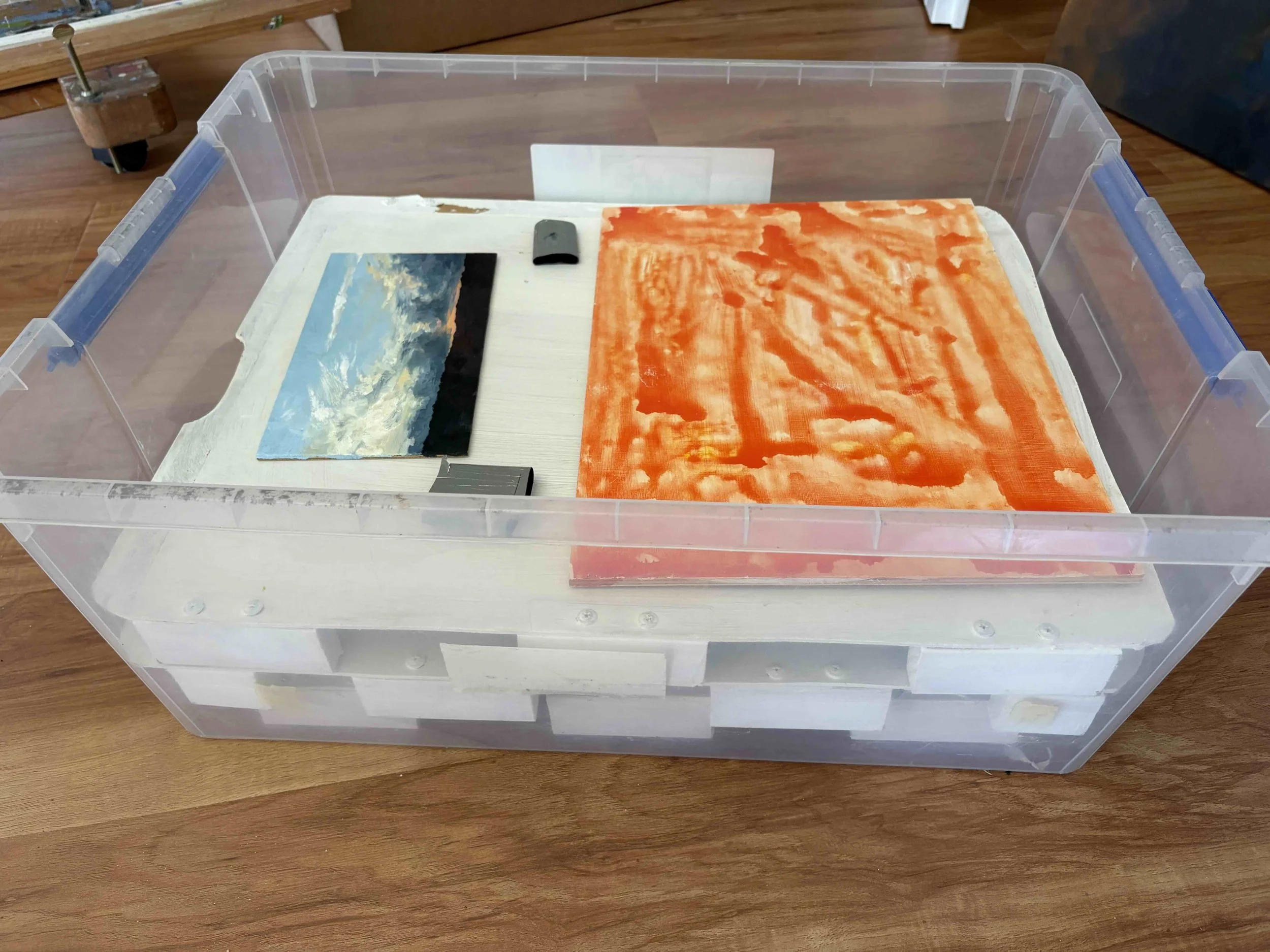
A box system I use for storing wet oil paintings on the road.

Brush rolls are great to store and protect brushes
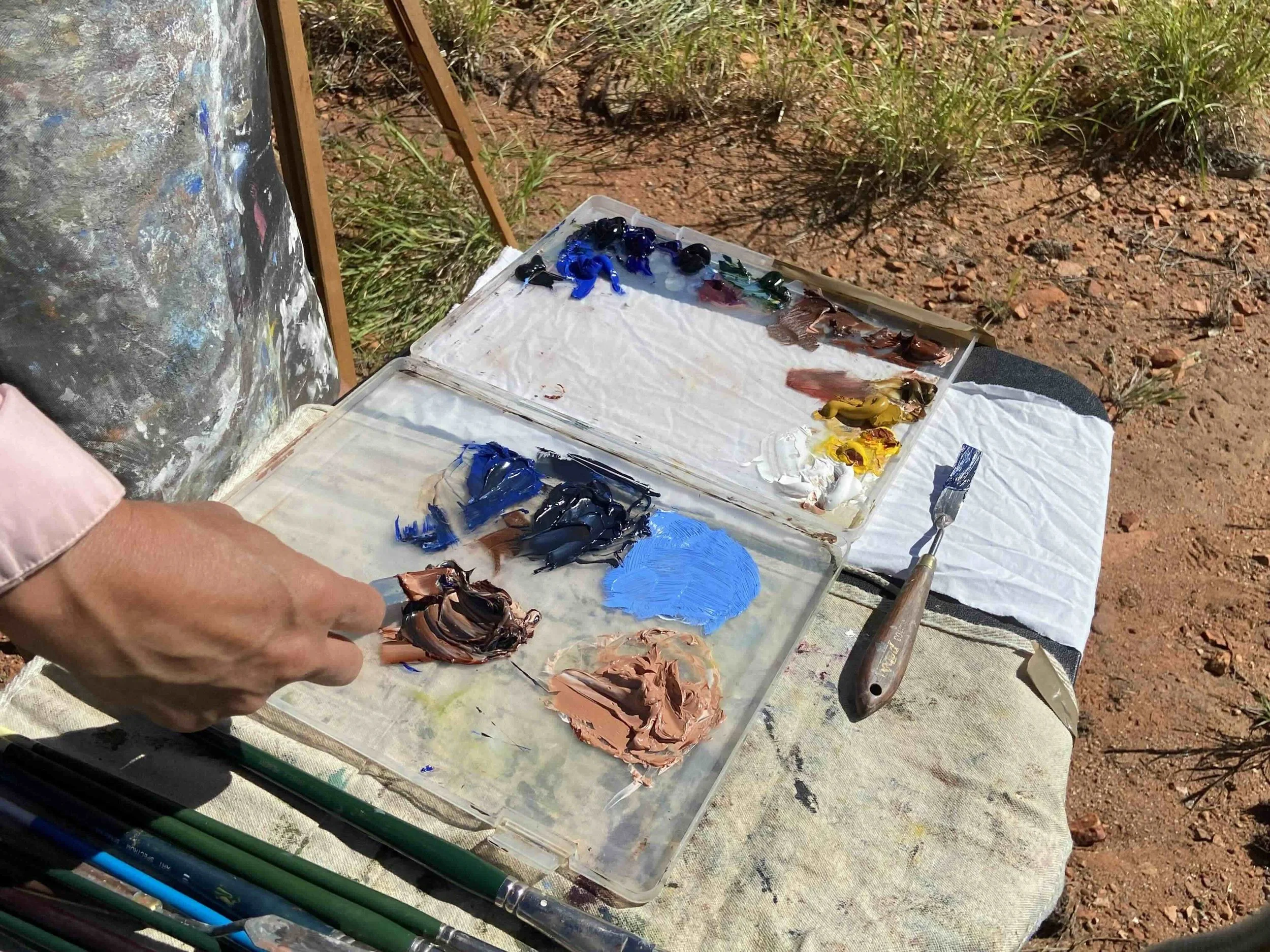
A plastic document holder that clips closed makes a light-weight and versatile palette
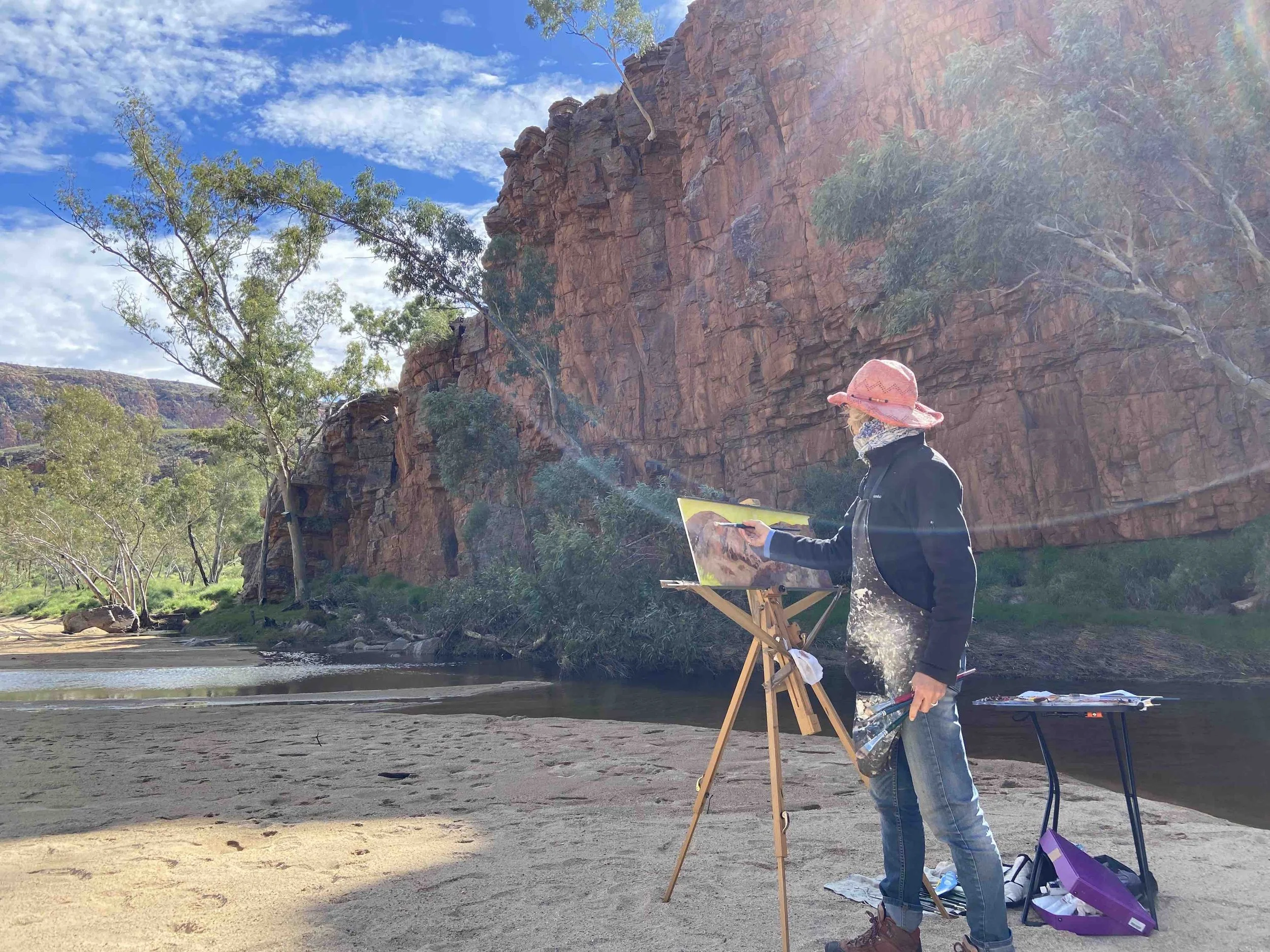
Plein air painting near Ormiston Gorge with portable folding table

Metal portable plein air painter's easel

Types of artist's brushes
Accommodation
Capertee Mountain View Artist Retreat is a place for people to reconnect with nature and their creativity. The farm offers paddocks to wander, cosy spots to relax, and beautiful, sweeping views to enjoy. Retreatants can paint in a landscape setting of their choice, whether painting rustic fences and sheds, open skies, or peaceful bushland.
Wake up to the birds and grazing kangaroos.
Capertee Mountain View Artist Retreat offers comfortable rooms and various styles of accommodation to suit different budgets and preferences.
Stay in the farmhouse, in one of our restored vintage vans in the paddocks or even under the stars in your own tent or campervan.
To help keep accommodation costs to a minimum, we ask that you bring your own linen - sheets and towels. If you're travelling from afar or have luggage limitations, feel free to email and we’ll happily make special arrangements for you.
During and at the conclusion of the retreat, you are kindly asked to maintain your room and participate in light shared housekeeping and farm tasks around the property. It’s all part of the community spirit that makes this experience so memorable.
You may choose to stay elsewhere in the Capertee Valley, Rylstone or Glen Alice regions and join us each day at Capertee Mountain View Retreats and the other painting locations, such as Glen Davis and From the Paddock.
Where you’ll sleep
Vintage Vans with Views
Stay in one of our delightfully restored and decorated vintage vans — Greta, Camilla, Poppy or Lizzie.
Each boasts a comfy double bed, kitchenette, heating and cooling, outdoor seating, and beautiful paddock views.
Enjoy access to shared bathrooms, a fully equipped kitchen, fire pit, outdoor communal studio, and relaxed living areas.
Please bring your own double bed sheets and towels
Peppertree Farm Cottage
The cottage provides simple but elegant living spaces and bedrooms, a large kitchen, verandahs to catch the morning sun, a hearth for fireside games and conversation, and a spacious dining table for shared meals. Watch the horses and sheep graze and enjoy the mountain views in changing light and weather.
Room options include:
QB with Ensuite
QB, shared bathroom
DB shared bathroom
Please bring your own sheets and towels
Paddock Camping
Bring your campervan, caravan, or tent and sleep under the stars with 360-degree valley views.
You’ll have access to shared bathrooms, a fully equipped kitchen, communal fire pit, studios, and shared living areas.
Accompanying Partner
If your partner would like to accompany you at Capertee Mountain View Artist Retreat, they are very welcome to share your accommodation, join us at the fireside and soak up the beautiful surroundings. An additional accommodation/amenities fee of $150 is payable. Simply let us know on the booking form and a separate invoice will be sent.
About The Capertee Valley
The spectacular Capertee Valley, north of Lithgow, is part of the Greater Blue Mountains, NSW, and lies just 185 km from Sydney and 81 km from Mudgee.
It is most easily accessed by car, but you can also take the train to Lithgow on the Blue Mountains Line from Sydney, then connect by coach from Lithgow to Capertee and arrange a pickup to the farm (let us know on your booking form and we’ll contact you to confirm times).
Access detailed directions to Capertee Mountain View Artist Retreat here.
Retreat Fees
Spring 2026
To keep things simple, there are two ways to book your place:
Pay in full
You may pay the full retreat fee of $650 plus your choice of on-site accommodation at the time of booking and save 5% on the total. Your place and accommodation are confirmed immediately. Input the discount code ‘5%OFF’ at checkout.
Deposit + balance
Alternatively, you can secure your place with a deposit of 40%, with the remaining balance due two months before the retreat. (No discount available). Input the code ‘DEPOSIT’ at checkout.
Payment Timing
If you choose the deposit option, the remaining balance must be paid no later than two calendar months before the retreat.
If full payment is not received by this time, your place may be released and offered to another participant.
A $50 late payment fee may apply if you wish to retain your place after the due date.
Partner Stay Contribution
$150 Accommodation & Amenities Fee
What People Say About the Retreats
-
![Retreat participant at Capertee with landscape painting]()
Corinne is an excellent teacher - she intuitively knows what each person needs and when.
She quietly goes round us all and gives that individual attention in a caring and encouraging way with real warmth and authenticity- highly supportive but also makes learning fun. Felt real joy and happiness and the group was highly positive engendered by the attention Corinne had created and the setting. The location meant we were all together and less travelling around so lots of painting productivity! Plus early morning yoga and evening walks. It was very well planned and a lot of care and attention
Nicky - Springwood
-
![Painting student at Capertee Valley retreat]()
I loved the timetable - tutorials balanced with practice
Our painting retreat in Capertee with Corinne was magnificent. The tutorials were highly instructive and met my needs as a beginning hobbyist but also seemed to hit the spot with the experienced artists. Corinne’s calm nature underpinned a beautiful feeling of wonder, discovery and fun.
Row - Glenbrook
-
![Female artist smiling at her painting on easel in Capertee Valley]()
I most enjoyed the location and being with like-minded people. It was so well organised, but very chill! I loved the walks, the meditation and the visit to From the Paddock.
I am so grateful for the whole experience and how much work went into making this an amazing experience. Corinne was extremely well-organised with a great and varied schedule. As well as sharing her own process in great detail, she also delivered some basic skills, which was a good mix for experienced and novice painters. The location is stunning, and I enjoyed painting at From the Paddock in the shearing shed.
Carol - Brisbane
-
![Woman in red standing painting outdoors at Capertee Valley Retreat]()
The choice of location is superb and inspires creativity.
I found the idea of resetting, as well as retreating was very beneficial for me. Corinne has a very structured approach to teaching. She has a knack of synthesising her years of painting experience into steps that can be readily managed, even for beginners. Wonderful learning experience!
Brenda - Cowra
-
![Woman with a brush in her hand standing in front of Capertee Mountains]()
I came with no knowledge and left inspired to learn more. I loved the camaraderie!
I came to the retreat with absolutely no painting experience and thoroughly enjoyed learning from Corinne and the other participants. Corinne’s tutorials were incredibly helpful and explicitly taught many aspects of plein air painting. It was a wonderful experience - very supportive, educational and fun. What a lovely place to unwind!
Janelle - Springwood
-
![Woman painting outdoors at the Capertee Painting Retreat]()
Such a restorative, creative space and people to be around.
Corinne’s teaching and advice was so helpful in taking my work to the next level. I felt encouraged by all her feedback. It was such a warm and positive atmosphere and group. I plan to do this again!
Kate - Blaxland
-
![Woman sitting beside oil painting of a barn in the Capertee Valley]()
Wonderful, fully immersive experience!
What I enjoyed the most on the retreat was focussed time to paint and being with people who validated that painting is worthwhile. I loved learning new things from Corinne’s valuable guidance and connecting with others.
-
![Female painting at an easel outdoors in Capertee Valley]()
Amazing location and I loved learning new skills with gentle encouragement.
A stunning environment of natural beauty, majestic vistas, abundant wildlife. Corinne is a very skilled educator and mentor, facilitates solving challenges and problems. She has a gentle considered way of giving very helpful feedback.
Lesley - Drummoyne