As I pack framed paintings, easels and glamorous outfits to perform with my pianist friend, Elyane in Melbourne, I am still basking in the glow of a wonderful weekend in nature, painting and making new friends.
The Capertee Valley turned out in all its majesty for us. Everyone embraced the challenges and delights of plein air painting - including the flitting of birds, the shifting shadows, peeling bark and gusty wind - all with a brush or palette knife in hand!
I was delighted to lead an enthusiastic group of painters in plein air painting, walking, meditation and yoga. We laughed and struggled together, ate delicious food and bathed in the beauty of the mountains of Glen Davis. Painting in the elements is intense - it requires grit, focus and courage to be bold and take risks. As you can see from the pics below, the men and women who came along, participated wholeheartedly and the overwhelming feedback was, ‘When can we do this again?’
Now it’s time to turn my attention south - towards the recital series with Elyane Laussade entitled Evoking the Elements. This project has been a long time in the pipeline… Each painting was conceived through many hours of attentive listening. Like cooking a new recipe, I worked in faith, trusting that the result of my labours would delight the tastebuds. Combining flavours, like fragrant spices, I have painted fire, craggy mountain peaks and night skies, searching for an essence - the ‘right’ depiction of the energy and dynamics of the music.
Debussy, Ravel, Chaminade and Chopin are just some of the composers in the repertoire. The paintings will be projected on a large screen and displayed on easels beside Elyane’s piano. With three performances in Melbourne and another in Castlemaine, this promises to be an experience to remember!
Tickets for the concerts on 12, 17 and 20 October are still available. You can book directly with Elyane at 0408 626 808.
Stay tuned for dates of the 2025 Autumn Capertee Painting Retreat and if you want to secure a spot, please let me know by email.
This work forms part of an ongoing investigation into painting in dialogue with musical structure. Referencing Automne by Cécile Chaminade, the painting engages with the central movement of the composition, where tempo and intensity begin to build.
The landscape is organised around directional movement, with a winding road and rising cloud formations guiding the eye through the image. Bare trees and dispersed foliage act as dynamic elements within the composition, contributing to a sense of momentum rather than stillness.
Executed alla prima, the painting retains a high degree of immediacy. Gestural brushwork and wet-on-wet handling allow forms to remain open and responsive, with marks accumulating in a way that parallels the increasing density and energy of the musical source.
The work operates between observation and translation, where landscape elements are reconfigured through rhythm, gesture and perceptual response. Rather than describing a fixed scene, it engages with a state of transition—where movement, atmosphere and structure are in flux.
Medium: Oil paint on plywood panel, framed in Italian timber
Subject: Autumn landscape with road, trees and cloud movement
Colour palette: Indigo blue, burnt sienna, yellow ochre, umber, grey, black
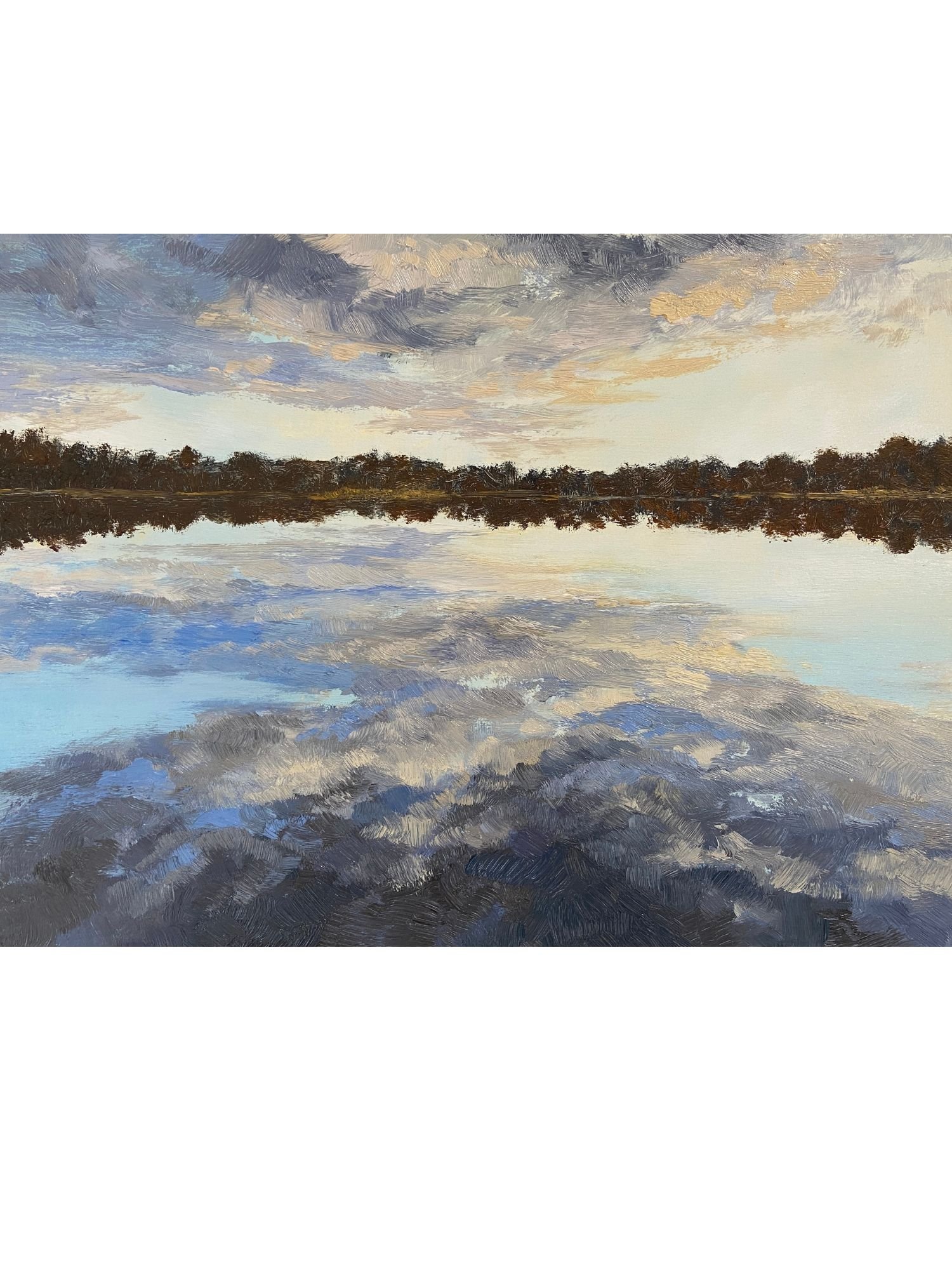
This work forms part of an ongoing investigation into painting in dialogue with musical structure. Referencing Ondine by Maurice Ravel, the painting engages with the fluid, unstable qualities of the composition—where surface, reflection and depth are continuously in flux.
The image is structured around water as both a reflective and destabilising field. Sky and atmosphere are doubled and reconfigured across the surface, creating an ambiguous spatial condition where depth is suggested but never fixed. The horizon dissolves into the surrounding field, allowing the painting to operate between surface and immersion.
Executed alla prima, the work retains immediacy and responsiveness. Wet-on-wet handling enables forms to shift and merge, with gestural marks accumulating in a way that parallels the layered, unfolding structure of the musical source.
Rather than illustrating the narrative associated with Ondine, the painting translates its underlying conditions—fluidity, tension and instability—into a visual language shaped by perception, movement and material process.
Medium: Oil paint on plywood panel, framed in Italian timber
Subject: Reflected sky and cloud formations across a water surface
Colour palette: Indigo blue, burnt sienna, yellow ochre, umber, grey, black
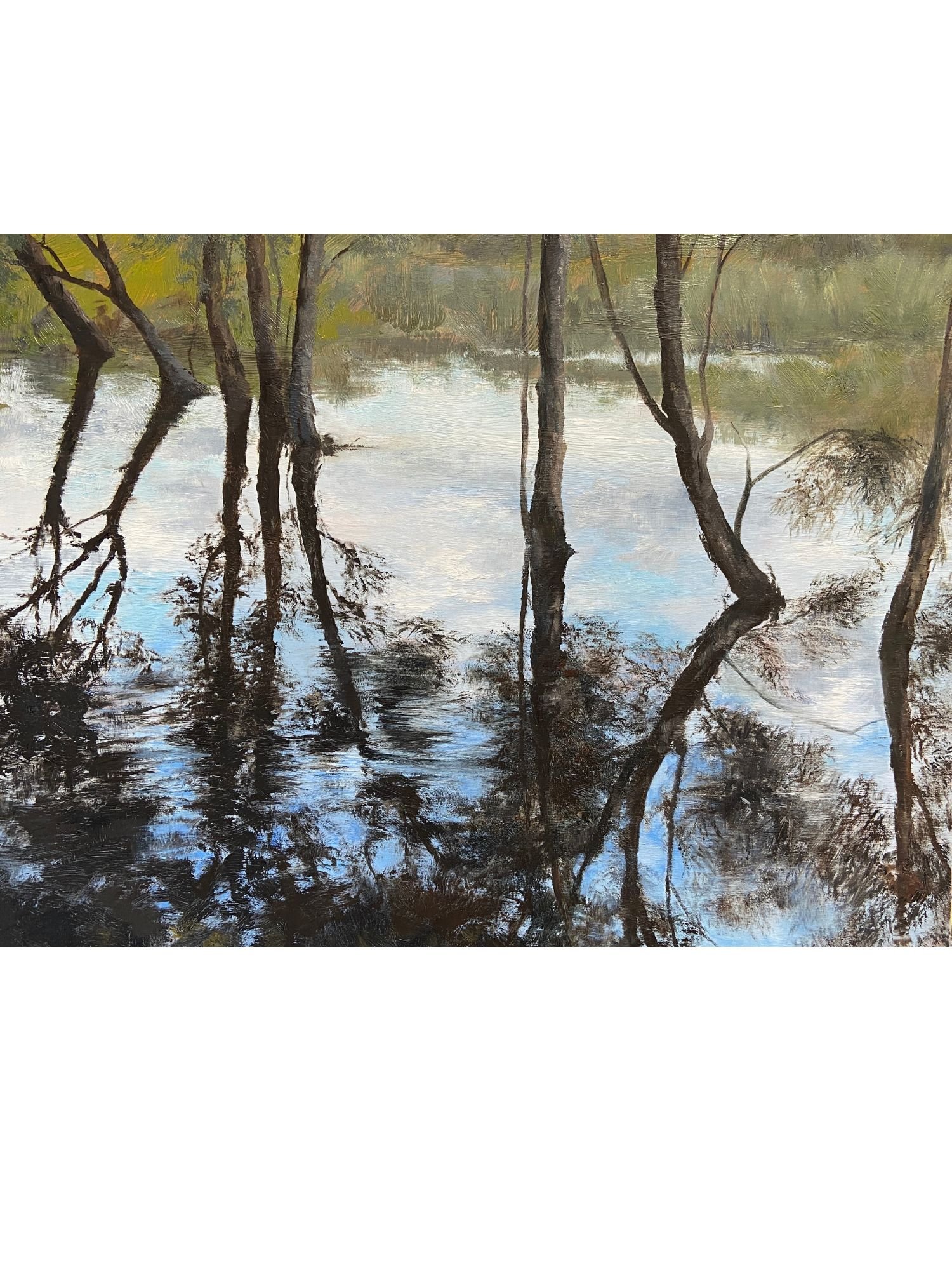
This work continues an investigation into painting in dialogue with musical structure. Referencing Ondine by Maurice Ravel, the painting engages with the shifting relationship between surface, depth and reflection, where spatial orientation remains deliberately unstable.
The composition is structured around a threshold condition. Darkened trees define the edge of the lagoon, acting as both a framing device and a point of resistance. Beyond this, the water operates as an active field—reflecting, doubling and reconfiguring the surrounding environment.
Reflections of sky and atmosphere collapse into the surface, creating an ambiguous spatial reading where boundaries between above and below are dissolved. The image oscillates between invitation and distance, drawing the viewer toward immersion while withholding a fixed point of entry.
Executed alla prima, the painting retains immediacy and responsiveness. Wet-on-wet handling allows forms to remain fluid and contingent, with gestural marks accumulating in a way that parallels the layered, unfolding structure of the musical source.
Rather than illustrating the narrative associated with Ondine, the work translates its underlying conditions—tension, fluidity and perceptual ambiguity—into a visual language shaped by movement and material process.
Medium: Oil paint on plywood panel, framed in Italian timber
Subject: Reflections of trees and sky across a lake surface
Colour palette: Indigo blue, burnt sienna, yellow ochre, umber, grey, black
This work forms part of an ongoing investigation into painting in dialogue with musical structure. Referencing the Winter Wind étude by Frédéric Chopin, the painting engages with rapid shifts in tempo, intensity and directional movement.
The composition is organised around a compressed horizon and an active sky, where cloud formations operate as carriers of velocity rather than static forms. Movement is sustained across the surface through layered, directional brushwork, allowing the image to unfold as a continuous field of energy.
Executed alla prima, the work retains immediacy and responsiveness. Wet-on-wet handling enables marks to remain fluid and unresolved, accumulating in a way that parallels the cascading structures and multi-directional flow of the musical source.
Rather than illustrating a specific scene, the painting translates the underlying conditions of the étude—force, momentum and instability—into a visual language shaped by gesture, rhythm and material process.
Medium: Oil paint on plywood panel, framed in Italian timber
Subject: Sky and cloud movement above a darkened tree horizon
Colour palette: Cerulean blue, indigo, burnt sienna, yellow ochre, white
This work forms part of an ongoing investigation into painting in dialogue with musical structure. Referencing the Mephisto Waltz by Franz Liszt, the painting engages with rapid escalation, contrast and volatility within the composition.
The image is organised around a charged horizon, where intense bands of colour compress and expand across the surface. Light is treated as an active force rather than a stable condition, generating zones of heat and tension that destabilise the surrounding field.
Cloud formations are driven by directional movement, with sweeping gestures reinforcing a sense of acceleration and release. The darker land mass anchors the composition, but also intensifies the instability above it, creating a dynamic interplay between structure and atmosphere.
Executed alla prima, the work retains immediacy and responsiveness. Wet-on-wet handling allows colour and form to remain fluid, with marks accumulating in a way that parallels the shifting tempo and intensity of the musical source.
Rather than illustrating narrative content, the painting translates underlying conditions—energy, contrast and transformation—into a visual language shaped by gesture, rhythm and material process.
Medium: Oil paint on plywood panel, framed in Italian timber
Subject: Dusk sky and cloud formations over a darkened horizon
Colour palette: Magenta, cadmium yellow, orange, vermilion, violet, umber, ultramarine, indigo, white
This work forms part of an ongoing exploration of painting in dialogue with musical structure. Referencing Automne by Cécile Chaminade, the painting translates shifts in tempo, tone and atmosphere into a visual language of light, colour and gesture.
The composition centres on a transitional landscape, where the horizon remains present but subdued, allowing the sky to operate as a primary field of movement. Bare trees and dry paddocks act as structural elements, anchoring the image while reinforcing a sense of seasonal reduction and spatial quiet.
Executed alla prima, the work retains immediacy and responsiveness, with wet-on-wet handling allowing tonal relationships to remain fluid and unresolved. The painting moves between description and abstraction, where observed elements are reorganised through rhythm, memory and perceptual response.
Rather than illustrating a specific moment, the work engages with the broader conditions of seasonal transition—where light, atmosphere and structure shift toward compression and stillness.
Medium: Oil paint on plywood panel, framed in Italian timber
Subject: Clouds over autumn trees and paddocks
Colour palette: Indigo blue, burnt sienna, yellow ochre, umber, grey, black